 Skip to content
Introduction
Switching to Aluminum Die Cast Shock Tower components is a cost-effective way to reduce the weight of the vehicle 30% to 45%, increase the EV range, create more design freedom, and lower production costs. The global aluminum die casting market is estimated to be worth USD 65 billion in 2025 and USD 70 billion by 2026. Of these, the automotive shock tower market is the fastest-growing.
A metal is three times denser than aluminum, but Aluminum Die Cast Shock Towers use topology optimization and high-pressure die casting to create lighter, stiffer components that can absorb more crash energy and are less susceptible to corrosion. Weight reductions have been reported as low as 16.5% to 45%, while maintaining the same strength and durability.
Weight Reduction: The Primary Performance Driver
The most immediate and tangible advantage of the Aluminum Die Cast Shock Tower is weight. Steel’s density sits at approximately 7.85 g/cm³; aluminum alloys typically range from 2.70 to 2.85 g/cm³—roughly one-third the mass for the same volume.
But the weight advantage does not stop at material density. Thanks to the design freedoms of die casting, Aluminum Die Cast Shock Tower units can integrate multiple steel stampings and weldments into a single, optimized casting. This part consolidation eliminates flanges, fasteners, and overlapping joints—each a source of parasitic mass.
Quantifying the Gains
| Metric | Steel Shock Tower (Stamped & Welded) | Aluminum Die Cast Shock Tower |
|---|---|---|
| Material Density | ~7.85 g/cm³ | ~2.70 g/cm³ (~1/3 of steel) |
| Typical Weight Range | 4.0–4.5 kg | 2.2–3.2 kg |
| Weight Reduction Achieved | Baseline | 25%–45% (documented in research) |
| Part Consolidation | Multiple stampings + welding | Single integrated casting |
| Joining Operations | Welding, riveting, and fasteners are required | Minimal (direct to subframe/body) |
In one study of an integrated shock tower design, the weight reduction reached 29% while maintaining yield strength above 170 MPa and elongation of at least 8.5%—performance metrics that satisfy the demanding requirements of modern passenger vehicles. Another project achieved a 16.5% reduction in body-in-white weight while meeting all performance specifications. These results are not anomalies. They represent the lower and middle ranges of what is consistently achievable with a well-engineered Aluminum Die Cast Shock Tower.
Weight Reduction and Driving Range in EVs
For battery electric vehicles, weight reduction is not merely about fuel economy—it directly translates to driving range, battery size, and vehicle cost. According to industry analyses, every 100 kg reduction in vehicle weight delivers roughly a 10% improvement in driving range. Since battery modules already account for over 30% of total vehicle mass, the lightweighting burden falls squarely on structural component material selection. An Aluminum Die Cast Shock Tower that saves even 1.5 kg compared to steel contributes meaningfully to this equation—especially when multiplied across multiple structural components in the front and rear assemblies.
Thin-walled aluminum castings have the added benefit of withstanding the highest operating temperatures of all die cast alloys, making them suitable for the demanding thermal environments found in EV powertrain compartments. Aluminum Die Cast Shock Tower designs also offer superior thermal conductivity, helping dissipate heat from nearby suspension components more effectively than steel.

Structural Performance: Stiffness, Strength, and Crash Behavior
The perception that “steel is stronger” only tells part of the story. Steel has a higher absolute Young’s modulus (≈200 GPa vs. aluminum’s 70 GPa), but aluminum excels in specific stiffness and strength-to-weight ratio. Properly designed Aluminum Die Cast Shock Towers can match or surpass steel in torsion and bending stiffness, thanks to topology optimization and high-pressure die casting.
What the Research Shows
Studies of aluminum shock towers demonstrate competitive or superior performance compared to steel. Weight reductions of 16.5% to 45% are achievable while maintaining stiffness, fatigue durability, and crash energy absorption. Aluminum’s lower modulus allows controlled, progressive deformation, protecting occupants without brittle failure.
Meeting Durability and Fatigue Requirements
Shock towers transfer high-impact loads from suspension to the vehicle body, so durability and fatigue resistance are critical. High-pressure vacuum-assisted die casting (HPVADC) ensures uniform mechanical properties and compliance with standards such as Chinese T/CSAE 199-2021, including fatigue, corrosion, and road reliability tests.Recent research shows HPDC aluminum alloys, even without heat treatment, provide sufficient yield strength, ultimate tensile strength, and elongation for structural applications. Eliminating heat treatment reduces cycle time, minimizes distortion, and maintains precision while delivering lightweight, high-performance components.
Design Freedom: Complex Geometries, Part Consolidation
Steel shock towers are typically constructed from multiple stamped sheets that are welded, riveted, or bolted together. Each stamping requires a dedicated die, each weld introduces a potential failure point, and each interface adds weight through flanges and fasteners. Design changes require modifying multiple tools—a costly and time-consuming process.
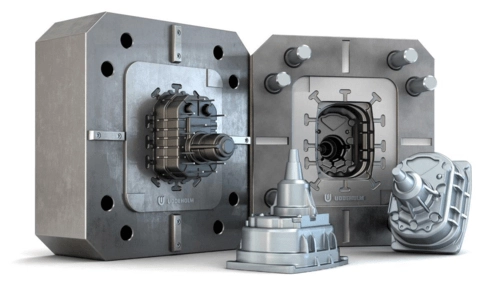
Aluminum die casting flips this paradigm. The HPDC process injects molten aluminum into a precision steel die at pressures up to 200 MPa and speeds of 10–50 m/s. This fills intricate cavities, ribs, bosses, and thin walls in a single shot. The result: a near-net-shape component that emerges from the die with critical features already in place, requiring minimal secondary machining. Aluminum Die Cast Shock Tower geometries can incorporate mounting points, reinforcing ribs, and even integrated cooling channels in ways that stamped steel simply cannot achieve.
Die Casting vs. Stamping: A Head-to-Head Comparison
| Factor | Stamping (Steel) | High-Pressure Die Casting (Aluminum) |
|---|---|---|
| Geometric Complexity | Limited to sheet-like forms with bends | High—ribs, bosses, undercuts, variable wall thickness |
| Part Count | Multiple stampings + assemblies | Single integrated casting |
| Secondary Operations | Welding, fastening, and alignment are required | Minimal (machining of critical interfaces) |
| Tooling Cost | Lower per simple part, but multiplied across the tooling set | Higher initial mold cost (amortized over volume) |
| Production Speed | Very high (hundreds per minute) | Moderate (melting, injection, cooling cycle) |
| Design Iteration Flexibility | High cost per revision (multiple tools) | Moderate (single tool modification) |
| Surface Finish Consistency | Variable (depends on stamping quality) | Excellent (reproducible die surface) |
The implication for procurement and engineering teams is profound. When evaluating total landed cost—including tooling amortization, assembly labor, quality control, and warranty risk—an Aluminum Die Cast Shock Tower frequently offers superior economics beyond relatively low production volumes. For runs of tens of thousands of units or more, the higher initial mold cost is more than offset by savings in assembly time, part count reduction, and weight-related benefits downstream.
Enabling Thin-Wall Casting
Modern aluminum alloys used in HPDC exhibit excellent castability, allowing complex, thin-walled geometries to be produced with precision. This capability is essential for shock towers, which must fit within tight packaging constraints while providing clearance for suspension articulation, steering components, and brake lines. The low viscosity of molten aluminum enables it to flow into thin sections as small as 1.5–2.5 mm, creating lightweight structures that are nonetheless fully functional. Aluminum Die Cast Shock Tower walls can be strategically thickened in high-stress zones and thinned elsewhere, achieving an ideal strength-to-weight ratio.
Cost Analysis: Tooling, Production, and Total Cost of Ownership
The upfront cost question is inevitable: Is aluminum die casting more expensive than steel stamping? The honest answer: it depends on volume and complexity. Let us break down the economics clearly.
Tooling Costs
Die casting molds are more complex and expensive than stamping dies. The reasons are straightforward: the die must withstand high injection pressures, rapid thermal cycling, and abrasive molten metal flow. Tool steels and cooling channel designs add cost. By contrast, stamping dies for sheet metal are simpler and less expensive to produce.
However, a single aluminum die casting replaces multiple stamping dies. If a steel shock tower assembly requires six stamping dies (for upper tower, lower tower, reinforcement plate, brackets, etc.), the total tooling investment may actually be comparable to or higher than the single die casting mold. Engineering teams should run a total-tooling calculation—not a per-die comparison—when making the steel-versus-aluminum decision. Aluminum Die Cast Shock Tower tooling, while more expensive upfront, typically lasts for hundreds of thousands of cycles when properly maintained.
Cycle Time and Production Rate
Stamping is faster per part. High-speed presses can achieve hundreds of cycles per minute, whereas die casting cycles are longer due to melting, injection, and cooling phases. For extreme high-volume applications exceeding 500,000 units per year, stamping’s higher throughput may provide a cost advantage that outweighs other factors.
But for the vast majority of vehicle models—production volumes in the tens of thousands to low hundreds of thousands—die casting’s cycle time is perfectly adequate. One die casting cell can produce hundreds to over a thousand shock tower castings per day, sufficient for most OEM requirements. Aluminum Die Cast Shock Tower production lines can also be automated extensively, reducing labor costs.
Total Cost of Ownership
When total cost of ownership is calculated (tooling + production + assembly + logistics + warranty + weight-related efficiency gains), Aluminum Die Cast Shock Tower solutions are often the lower-cost solution in the long run. The part consolidation eliminates welding stations, fastener insertion operations, and quality inspection points. The weight reduction improves fuel economy or EV range—a quantifiable value to the end customer. Corrosion resistance reduces warranty claims. These factors collectively shift the economic equation decisively toward aluminum for modern vehicle platforms.
For procurement professionals, the recommendation is clear: run a total-cost-of-ownership model that includes assembly savings, logistics weight savings (shipping lighter components reduces freight costs), and efficiency gains. In most applications above 30,000–50,000 units annually, Aluminum Die Cast Shock Tower is not only technically superior but economically advantageous as well.
Corrosion Resistance and Longevity
Steel rusts. It is a chemical inevitability. Even galvanized or coated steel surfaces eventually succumb to corrosion when chips, scratches, or weld burns expose bare metal to moisture and road salts. Once corrosion initiates, it progresses—often invisibly behind paint or underbody coatings—compromising structural integrity over time.
Aluminum does not rust. It forms a naturally occurring, self-repairing oxide layer (Al₂O₃) when exposed to oxygen. This oxide film is hard, adherent, and passive—it blocks further oxidation. In automotive applications, this means an Aluminum Die Cast Shock Tower retains its structural properties and cosmetic appearance for the full life of the vehicle without requiring heavy anti-corrosion coatings.
Salt Spray Testing Validation
According to national standards for aluminum alloy vehicle shock towers, corrosion resistance testing is mandatory. Components must pass neutral salt spray tests demonstrating no unacceptable pitting, blistering, or structural degradation after specified exposure periods. Aluminum die castings routinely pass these tests with margins that exceed steel equivalents, particularly in regions where winter road salting is common. Aluminum Die Cast Shock Tower samples have been documented to withstand over 1,000 hours of salt spray without structural degradation.
For manufacturers exporting vehicles to northern Europe, North America, and East Asia (where de-icing salts are heavily used), the corrosion resistance of aluminum represents a genuine competitive advantage. It reduces warranty claims, improves customer satisfaction, and extends vehicle service life.
Sustainability: The Circular Advantage
Automotive manufacturers are under increasing pressure to reduce carbon footprints and incorporate recycled content. By 2035, the European Union aims for new vehicles to be manufactured almost entirely from recycled materials—a target that will save over 1.5 tons of material per vehicle. Meeting these targets requires a fundamental shift in material selection.
Aluminum is infinitely recyclable without loss of properties. The die casting industry has recognized this potential: the FlexCrash European project is actively developing lighter, safer, and circular crash structures for automobiles using recycled aluminum alloys processed by high-pressure die casting. The goal is to produce vehicle parts without new raw materials. Aluminum Die Cast Shock Tower components made from secondary aluminum have identical mechanical properties to those made from primary metal.
The Case for Secondary Aluminum
Trimet, a major aluminum producer, has developed die-casting alloys from secondary (recycled) aluminum to advance resource-efficient production in the automotive industry. Honda has implemented horizontal recycling of aluminum die-cast scrap, achieving 100% recycling of the same alloy series in closed-loop production—converting scrap from manufacturing back into identical high-quality components.
For a shock tower—a component made from a single alloy with minimal contamination risk—the potential for closed-loop recycling is substantial. Scrap from production (sprues, runners, defective castings) can be returned directly to the melt furnace without downgrading the material. At the end of vehicle life, the Aluminum Die Cast Shock Tower can be reclaimed and recast into new automotive components, completing the circular loop.
Carbon Footprint Comparison
The embodied carbon of primary aluminum is higher than that of steel on a per-ton basis due to the energy-intensive electrolytic smelting process. But the calculation changes dramatically when weight and recyclability are factored in. Producing a lighter aluminum component reduces fuel consumption (or electricity demand) over the vehicle’s entire operating life, offsetting the upfront carbon. Furthermore, using recycled aluminum reduces energy consumption by approximately 95% compared to primary production.
For automotive OEMs with Scope 3 emissions targets, switching to Aluminum Die Cast Shock Tower structural components is one of the most effective levers available. Research on sustainable car body concepts, including the FutureCarProduction flagship project involving eight Fraunhofer institutes, is exploring how state-of-the-art casting technologies can be evaluated for sustainability and recyclability to conserve resources. The conclusion emerging from this research is consistent: aluminum die casting is not only a lightweighting solution but also a sustainability solution.
Application Scenarios: Where Aluminum Die Cast Shock Towers Excel
Battery Electric Vehicles (BEVs)
EVs benefit disproportionately from weight reduction. Every kilogram saved extends range or reduces battery pack size—and batteries are the single most expensive component in an EV. For EV platforms, particularly those in the C-segment (compact) and above, Aluminum Die Cast Shock Tower designs are rapidly becoming standard. The combination of weight reduction, corrosion resistance, and design freedom aligns perfectly with EV architecture requirements, including flat floor battery integration and optimized crash load paths.
High-Performance and Luxury Vehicles
For premium brands, unsprung mass reduction is a handling differentiator. Lighter shock towers reduce the mass that the suspension must control, allowing springs and dampers to respond more quickly to road inputs. The result is sharper turn-in, better road holding, and reduced body roll. High-performance vehicles from manufacturers like Porsche and BMW increasingly incorporate aluminum die cast suspension components, and the Aluminum Die Cast Shock Tower is a natural extension of this strategy.
Large SUV and Pickup Segments
Heavier vehicles have more to gain from lightweighting. Large SUVs and pickups, which often carry high gross vehicle weights, can achieve meaningful fuel economy improvements through structural weight reduction without compromising payload capacity. The Aluminum Die Cast Shock Tower’s corrosion resistance is particularly valuable in these segments, as such vehicles are frequently used in harsh environments (off-road, winter towing, etc.).
Platform Sharing and Modular Architecture
Modern vehicle platforms are designed to accommodate multiple body styles and powertrains. A Aluminum Die Cast Shock Tower designed with sufficient design margin can serve across BEV, hybrid, and internal combustion derivatives of the same platform, reducing tooling investment and simplifying supply chain management.
FAQ
1. Is an aluminum die cast shock tower as strong as a steel one?
Yes, for the loads a shock tower encounters. Aluminum’s lower absolute stiffness is offset by optimized geometry and thicker sections where needed. Properly designed Aluminum Die Cast Shock Tower components meet or exceed all strength, stiffness, and durability requirements.
2. How much weight can an aluminum die cast shock tower save?
Research shows 16% to 45% weight reduction versus steel, depending on design optimization and whether integrated die casting is used. A typical Aluminum Die Cast Shock Tower in production achieves 25% to 35% savings.
3. Does aluminum die casting cost more than steel stamping?
Upfront tooling is higher, but the total cost of ownership (assembly, logistics, warranty) is often lower. For volumes above approximately 30,000–50,000 units annually, the Aluminum Die Cast Shock Tower is generally cost-competitive or superior.
4. Are aluminum die cast shock towers suitable for EVs?
Absolutely. EVs benefit most from weight reduction. Every kilogram saved extends driving range by roughly 0.1%. Aluminum Die Cast Shock Tower solutions are widely used in modern EV architectures.
5. How does corrosion resistance compare between aluminum and steel?
Aluminum forms a self-repairing oxide layer and does not rust. An Aluminum Die Cast Shock Tower resists road salts and moisture without heavy coatings, reducing warranty claims and extending service life.
Conclusion
Aluminum Die Cast Shock Towers offer 25%–45% weight reduction, enhanced design freedom, excellent corrosion resistance, and full recyclability—all at competitive costs.
The automotive industry is moving toward lightweight components, driven by electrification, emissions rules, and customer expectations. Shock towers are a high-impact application of aluminum die casting.
Whether for new EV platforms or high-volume production, these shock towers should be in your specifications. Contact our team for DFM reviews, prototyping, and full-scale die casting services—submit drawings or 3D models for a no-obligation assessment and start building lighter, stronger, sustainable vehicles today.