 Skip to content
Abstract:
Aluminum alloy die castings are highly valued in automotive, electronics, aerospace, and industrial manufacturing due to their exceptional combination of lightweight durability, corrosion resistance, efficient thermal conductivity, and precise dimensional accuracy.
According to materials data from The Aluminum Association and alloy classifications established by ASTM International, these die casting alloys are specifically engineered as aluminum–silicon–copper or aluminum–magnesium systems to enhance fluidity, pressure retention, mechanical strength, and overall casting quality.
Complementing this, technical insights from SAE International underline the crucial role of alloy selection in controlling porosity, ensuring machinability, enhancing heat resistance, and promoting long-term reliability.
This comprehensive 2026 industry guide provides detailed insights into the aluminum alloys commonly used in die casting processes. It explores why specific alloys dominate global markets, how their chemical composition affects mechanical properties, and the criteria for selecting the most suitable alloy for your specific application or project.
Introduction: Why Alloy Selection Defines Die Casting Performance?
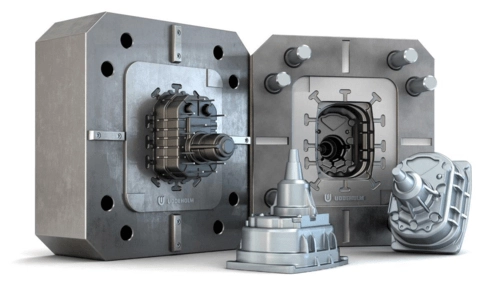
Die casting is a precision metal forming method that utilizes high pressure to inject molten aluminum into robust steel molds. This technique allows the creation of intricate shapes, thin walls, and supports large-scale production with remarkable consistency.
However, the ultimate performance of a casting extends beyond its geometry; it is heavily influenced by the composition of the alloy used. Selecting an inappropriate alloy can lead to several issues, including:
- – Porosity defects
- – Cracking or hot tearing
- – Lower fatigue resistance
- – Subpar surface quality
- – Difficulties during machining
- – Accelerated corrosion
For this reason, choosing the right aluminum alloy for die casting isn’t merely a matter of materials science—it is a critical and strategic engineering decision that profoundly impacts the final product’s functionality and durability.
What Makes an Aluminum Alloy Suitable for Die Casting?
Not all aluminum alloys are ideal for die casting, as the process requires particular properties to ensure optimal results:
- High Fluidity
The alloy must allow molten aluminum to flow seamlessly into intricate and thin sections before it solidifies. Adding silicon significantly enhances this fluidity.
- Low Shrinkage
Minimizing shrinkage during solidification helps reduce internal stresses and the likelihood of porosity in the final cast.
- Resistance to Hot Cracking
The composition of the alloy should be tailored to prevent cracking caused by solidification under high-pressure conditions.
- Mechanical Strength
The finished components need to withstand the structural loads expected in their designated applications.
- Corrosion Resistance
This is particularly vital for parts used in demanding environments such as the automotive or marine industries.
- Good Machinability
Since secondary processing is often required for aluminum alloy die castings, the material must exhibit favorable machinability.
Performance categories of aluminum die-casting alloys are primarily influenced by the presence of silicon and copper as key alloying elements.

Most Common Aluminum Alloys Used for Die Casting
Globally, a limited group of alloys dominates industrial production.
-
A380 Aluminum Alloy – The Industry Standard
A380 is the most widely used alloy in aluminum die casting.
Why the A380 Is Popular?
Excellent fluidity
Good pressure tightness
Balanced strength and corrosion resistance
Cost-effective
Typical Applications
Automotive transmission housings
Electronic enclosures
Power tool bodies
Pump housings
A380 offers the best compromise between performance and manufacturability.
-
ADC12 – The Asian Market Equivalent
ADC12 is widely used in Asia and is comparable to A380.
It provides:
- High castability
- Good wear resistance
- Stable dimensional tolerance
It is especially common in Japanese and Chinese automotive production systems.
-
A383 Aluminum Alloy
A383 is similar to A380 but optimized for:
- More complex components
- Improved hot cracking resistance
It is often chosen when the part geometry is intricate.
-
A360 Aluminum Alloy
A360 offers:
- Superior corrosion resistance
- Higher strength
- Better ductility
However, it has lower fluidity compared to A380, making it slightly more difficult to cast.
-
AlSi10Mg (High-Performance Alloy)
This alloy is known for:
- High strength-to-weight ratio
- Excellent fatigue performance
- Improved thermal resistance
It is common in aerospace and high-end automotive applications.

Chemical Composition Comparison
| Alloy | Silicon (%) | Copper (%) | Magnesium (%) | Key Advantage |
| A380 | 7.5–9.5 | 3.0–4.0 | <0.1 | Balanced properties |
| A383 | 9.5–11.5 | 2.0–3.0 | <0.1 | Improved crack resistance |
| A360 | 9.0–10.0 | <0.6 | 0.4–0.6 | Corrosion resistance |
| ADC12 | 9.6–12.0 | 1.5–3.5 | <0.3 | High castability |
| AlSi10Mg | 9–11 | <0.5 | 0.2–0.45 | High strength |
Silicon improves fluidity and reduces shrinkage. Copper increases strength but reduces corrosion resistance. Magnesium enhances mechanical performance.
Mechanical Property Comparison
| Alloy | Tensile Strength (MPa) | Yield Strength (MPa) | Elongation (%) |
| A380 | 310 | 160 | 3.5 |
| A383 | 320 | 170 | 3 |
| A360 | 330 | 170 | 5 |
| ADC12 | 290 | 150 | 2.5 |
| AlSi10Mg | 340+ | 200 | 4–8 |
The correct alloy depends on structural versus cosmetic requirements.
Application-Specific Alloy Selection
Choosing the correct alloy is the most critical decision in die casting projects. Each alloy offers different mechanical, thermal, and corrosion performance.
- Automotive Structural & Powertrain Components
Common requirements:
- High strength
- Good fatigue resistance
- Thermal conductivity
- Pressure tightness
Typical alloys:
- A380 – Excellent castability and good mechanical properties
- ADC12 – Widely used in Asia; good fluidity and cost efficiency
- AlSi10Mg – Higher strength potential (often in structural casting applications)
Applications:
- Transmission housings
- Engine brackets
- Motor housings (EV)
- Electronics & Thermal Management
Key requirements:
- High thermal conductivity
- Dimensional precision
- Good surface finish
Typical alloys:
- A360 – Better corrosion resistance than A380
- AlSi9Cu3 – Balanced strength and thermal performance
Applications:
- LED housings
- Heat sinks
- 5G communication enclosures
- Industrial Equipment & Machinery
Key requirements:
- Structural integrity
- Wear resistance
- Machinability
Common alloys:
- A380
- ADC12
- AlSi12
These alloys offer a good balance between cost and mechanical performance.
- Thin-Wall or High-Fluidity Designs
For complex or thin-wall designs:
- ADC12
- A380
- High-silicon alloys (improved fluidity)
Higher silicon improves castability but may reduce ductility.
- Food, Medical, and Corrosion-Sensitive Environments
Preferred:
- Lower copper alloys
- AlSiMg alloys
Copper increases strength but reduces corrosion resistance.
Corrosion Resistance Considerations
Corrosion behavior depends heavily on alloy composition and surface treatment.
- Influence of Alloying Elements
- Silicon (Si) → Improves castability and moderate corrosion resistance
- Copper (Cu) → Increases strength but reduces corrosion resistance
- Magnesium (Mg) → Improves strength and corrosion resistance
- Iron (Fe) → Improves die release but may create brittle phases
High-copper alloys (e.g., A380) are less suitable for marine or high-humidity applications without coating.
- Environmental Exposure Factors
Consider:
- Salt spray (marine or automotive road salt)
- High humidity
- Industrial pollutants
- Galvanic coupling with steel fasteners
In automotive applications, corrosion resistance must meet salt spray testing standards (e.g., 240–1000+ hours depending on OEM requirements).
- Surface Treatment Options
To improve corrosion resistance:
- Powder coating
- Anodizing (limited to high-silicon alloys)
- Chromate conversion coating
- Electroless nickel plating
High-silicon die cast alloys are more difficult to anodize uniformly compared to wrought aluminum.
- Galvanic Corrosion Prevention
When assembled with:
- Steel bolts
- Copper components
- Stainless steel parts
Use:
- Insulating washers
- Protective coatings
- Design isolation strategies
Heat Treatment and Post-Processing
Die casting differs from gravity casting because high pressure introduces porosity risks.
- Heat Treatment Limitations
Traditional die castings are often:
- Not T6 heat-treated
- Limited in solution heat treatment due to gas porosity expansion
However, vacuum die casting and squeeze casting now allow improved heat treatment capability.
- T5 vs T6 Treatment
- T5 → Artificial aging without solution treatment
- T6 → Solution heat treatment + aging
Vacuum die casting enables structural components to achieve higher mechanical properties using T6 processes.
- Machining and Secondary Operations
Post-processing may include:
- CNC machining
- Drilling and tapping
- Surface polishing
- Shot blasting
Alloy selection affects machinability. High-silicon alloys improve wear resistance but increase tool wear.
- Impregnation for Leak Prevention
Pressure-tight components may require:
- Vacuum impregnation
- Resin sealing
- Especially for:
- Pump housings
- Gearbox cases
- EV battery cooling plates
Cost Considerations
Total cost is influenced by more than alloy price alone.
- Raw Material Cost
Cost factors:
- Aluminum market price (LME fluctuations)
- Alloying elements (Cu, Mg, Zn)
- Recycled aluminum content
High-copper alloys may cost slightly more but improve strength.
- Casting Yield and Scrap Rate
High fluidity alloys reduce:
- Cold shuts
- Misruns
- Scrap rates
Lower scrap improves overall project economics.
- Tooling Investment
Die casting requires:
- High initial mold cost
- Precision tooling
- Cooling channel optimization
However, high-volume production significantly lowers per-unit cost.
- Cycle Time and Productivity
Aluminum die casting offers:
- Fast cycle times (seconds per part)
- High automation compatibility
- Multi-cavity production
Faster cycles reduce energy cost per unit.
- Post-Processing Costs
Consider:
- Machining time
- Surface treatment
- Heat treatment
- Quality inspection
Choosing the right alloy can reduce secondary processing requirements.
Common Mistakes in Alloy Selection
Selecting a high-strength alloy when fluidity is more important
Ignoring corrosion exposure
Over-specifying mechanical properties
Failing to match the alloy to the casting machine’s capability
Overlooking secondary machining requirements
Material selection should align with application priorities.
Emerging Trends in Aluminum Alloy Die Castings (2026)
The industry is evolving toward:
- Low-carbon recycled aluminum alloys
- Vacuum-assisted die casting
- Structural giga-casting for EV platforms
- Heat-treatable high-ductility alloys
- AI-based defect prediction
Electric vehicle manufacturers increasingly require structural-grade Aluminum Alloy Die Castings with improved crash performance.
How to Choose the Right Alloy: Practical Selection Framework?
Consider the following decision hierarchy:
- Structural load requirement
- Corrosion environment
- Casting complexity
- Surface finish expectation
- Budget constraint
- Secondary processing needs
Consult alloy data sheets and work with experienced die casting partners.
FAQ: Aluminum Alloy Die Castings
Q1: What is the most commonly used aluminum alloy for die casting?
The A380 is the most widely used due to its balanced properties.
Q2: Is ADC12 the same as A380?
They are similar but not identical in composition and performance.
Q3: Can die-cast aluminum be heat-treated?
Some advanced processes allow heat treatment, but traditional die-cast parts often have porosity limitations.
Q4: Which alloy has the best corrosion resistance?
A360 generally offers better corrosion resistance due to lower copper content.
Q5: What alloy is best for automotive applications?
A380 and ADC12 are commonly used in automotive die casting.
Conclusion
Selecting the correct alloy for Aluminum Alloy Die Castings is critical for mechanical performance, corrosion resistance, manufacturability, and cost efficiency. While A380 dominates global production, alternatives such as A383, A360, ADC12, and AlSi10Mg provide tailored advantages for specialized applications.
As die casting technology advances toward structural and EV-grade components, alloy engineering continues to evolve. Understanding the interplay between chemistry, casting behavior, and application requirements allows manufacturers to optimize product performance and long-term durability in 2026 and beyond.