 Skip to content
Abstract
Coupling blocks are vital mechanical parts employed in power transmission systems to link rotating shafts, allowing for misalignment and torque transfer.
This detailed guide examines the basics of coupling blocks, their operational principles, technical details, and industrial uses to assist engineers and procurement specialists in making well-informed choices for their machinery setups.
Understanding Coupling Blocks: Definition and Core Components
What is a Coupling Block?
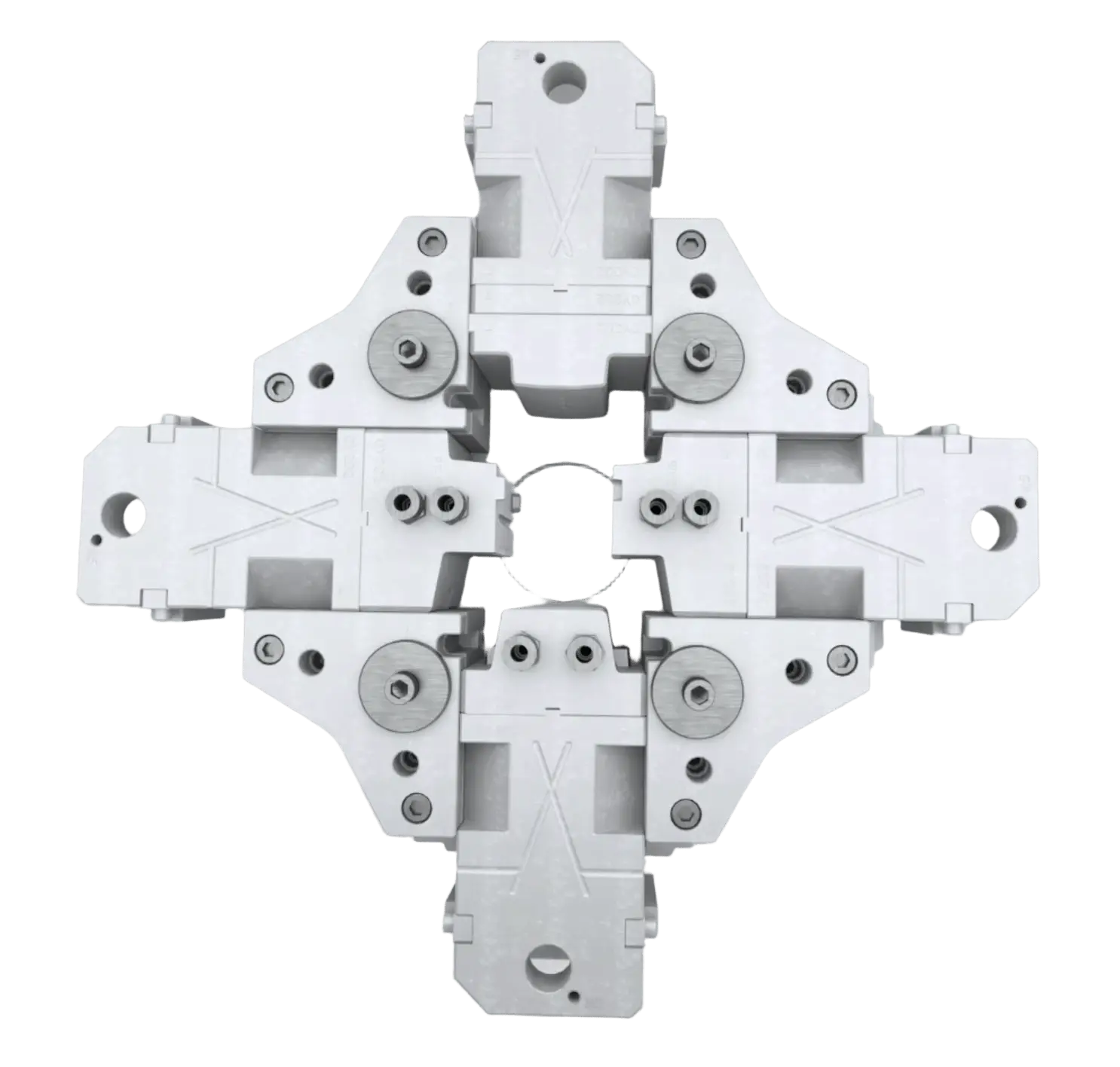
A coupling block is a device used for mechanical power transmission that connects two rotating shafts while accommodating installation misalignment and damping operational vibrations. Unlike rigid couplings, which need precise shaft alignment, coupling blocks use elastomeric components enclosed in a metal casing to enable flexible torque transfer. The basic design includes two hubs attached to each shaft, linked by a resilient intermediate element that permits controlled deflection during use.
The main role of coupling blocks focuses on three key performance aspects: transmitting torque between the driver and driven equipment, accommodating misalignment caused by thermal expansion or foundation settling, and reducing vibrations to shield connected machinery from shock loads. These parts are especially useful in situations where achieving exact shaft alignment is challenging or where operational conditions lead to dynamic misalignment.
Coupling blocks set themselves apart from traditional flexible couplings due to their modular design. This allows for quick replacement of the elastomer without removing the shaft. The block housing design ensures better containment of the flexible element while maintaining consistent compression properties at the torque transmission interface. This structure generally extends service life by 30-40% compared to standard jaw-type couplings under similar operating conditions.
Essential Components and Material Specifications
The coupling block assembly consists of four main parts: the housing block, elastomeric insert, drive hubs, and fastening hardware. Housing blocks are usually made from gray cast iron (GG25/ASTM Class 30) for regular uses or ductile iron (GGG40/ASTM 60-40-18) in high-shock conditions. High-end versions use steel alloy housings (C45 grade) when the highest strength-to-weight ratio is needed, especially in high-speed applications over 3,600 RPM.
Elastomeric elements are the essential wear components, and the choice of material directly affects their service life and performance features. Standard polyurethane formulations have a Shore A hardness between 80 and 95, with softer variants (80-85 Shore A) offering better vibration damping, while harder types (90-95 Shore A) provide increased torque capacity. Natural rubber options have superior temperature resistance (-40°C to +80°C) compared to the typical polyurethane range (-20°C to +60°C), making them more suitable for outdoor use or environments with temperature fluctuations.
Drive hubs have precision-machined bores with keyway slots that meet DIN 6885 or ISO R773 standards. The hub materials are usually C45 carbon steel, surface-hardened to 55-60 HRC in the bore area, providing wear resistance during repeated start-stop cycles.
Fastening mechanisms consist of high-tensile bolts (at least Grade 8.8) with torque specifications between 25 and 150 Nm, depending on the coupling size. Larger frame sizes feature hydraulic hub mounting systems to make installation easier and to ensure concentric shaft engagement.
Load-bearing capacities differ greatly among coupling block sizes. Standard industrial ranges support continuous torque ratings from 50 Nm, suitable for small frame sizes in servo applications, up to 25,000 Nm for heavy industrial variants used in mining and cement processing. Service factors ranging from 1.5 to 2.5 are used to account for shock loading. Specific multipliers are set for reciprocating equipment, multi-cylinder engines, and impact machinery.

How Coupling Blocks Work: Operating Principles and Mechanisms
Torque Transmission Mechanism
Torque transfer in coupling blocks happens via compression loading of the elastomeric element between opposing hub faces. When the driving shaft turns, tangential forces arise at the hub-elastomer interface, generating shear and compression stresses within the flexible component.
This method of transmission, based on compression, is fundamentally different from jaw couplings, which mainly depend on shear loading, leading to a more even stress distribution and a longer lifespan for the elastomer.
The force transfer pathway follows a defined sequence: rotational input from the driving hub generates compressive forces on the elastomer’s leading face, which transmits through the element’s cross-section to the trailing hub face, ultimately delivering torque to the driven shaft.
Power transmission efficiency in properly maintained coupling blocks typically exceeds 98.5%, with losses attributed primarily to hysteresis within the elastomeric material during cyclic compression.
Friction coefficients between hub surfaces and elastomer faces range from 0.6 to 0.8 for polyurethane compounds, providing adequate grip to prevent slip under rated torque conditions. Surface finish specifications on hub faces (Ra 3.2-6.3 μm) balance the need for mechanical interlock against excessive stress concentration that could initiate elastomer tearing.
The compression principle inherently provides overload protection, as excessive torque causes controlled slip rather than catastrophic component failure, offering a mechanical fuse function that protects downstream equipment.
Misalignment Compensation Capabilities
Coupling blocks allow for three main types of misalignment by controlling elastomer deflection. The tolerance for angular misalignment usually varies from 0.5° to 1.5°, depending on the size of the coupling and the hardness of the elastomer, with smaller frame sizes generally allowing for larger angular deviations because of decreased moment arm effects. This angular flexibility is crucial in belt-driven systems where pulley loads cause shaft deflection or in vertically mounted pump applications where the rotor’s weight causes an angular offset.
Parallel misalignment compensation varies from 0.2 to 0.8 mm for standard industrial coupling blocks, which is accomplished by asymmetric compression of the elastomeric element. The design of the block housing limits lateral movement while allowing controlled deflection, avoiding contact between the hub and housing that could lead to metal-to-metal wear. The ability to accommodate parallel offset is especially useful in long-span drive systems where thermal expansion results in shaft centerline displacement or in skid-mounted equipment where foundation settling causes gradual misalignment.
Axial displacement accommodation usually allows for 1-3 mm of shaft movement, which helps manage thermal expansion in high-temperature environments or compensates for bearing wear without needing to replace the coupling. The compression properties of the elastomer generate a restoring force that keeps the hub engaged while enabling limited axial movement, thereby avoiding excessive bearing load caused by thermal expansion.
Vibration-damping properties provide a notable operational benefit, as elastomeric components reduce torsional vibrations by 40-60% compared to rigid coupling options. The material’s natural damping coefficient (tan δ = 0.1-0.2 for polyurethane) transforms vibrational energy into heat, decreasing resonance amplitudes in drive systems functioning near critical speeds. This damping capability prolongs bearing life by 25-35% in standard industrial uses by lowering peak dynamic loads during start-up transients and load variations.
Technical Specifications and Selection Criteria
Key Performance Parameters
Proper coupling block selection requires evaluation of multiple interdependent performance parameters. Torque ratings are the primary criterion for selection, with nominal torque (Tn) defined as the continuous torque capacity during steady-state operation.
Manufacturers specify maximum torque (Tmax) at 1.5-2.0 times the nominal rating to account for transient overloads, although sustained operation above the nominal torque speeds up elastomer degradation and shortens service life proportionally.
Speed limitations result from centrifugal forces acting on the elastomeric element and housing assembly. Standard coupling blocks support operational speeds up to 3,600 RPM for balanced installations, while high-speed variants are available for applications reaching 7,200 RPM through improved dynamic balancing (ISO 1940 G6.3 or better) and reinforced elastomer retention features. Speed-torque relationships are inversely proportional, as power transmission capacity (P = T × ω) permits smaller coupling choices at higher rotational speeds for the same power levels.
Bore diameter ranges from 10 mm (fractional horsepower applications) to 250 mm (heavy industrial drives). Hub designs accommodate both cylindrical and tapered shaft configurations. Keyway dimensions follow standard proportions, but splined connections or hydraulic shrink-fit options offer increased torque capacity in high-end coupling designs.
Service factors adjust the base torque ratings based on the characteristics of the driven equipment: 1.5 for uniform loads such as centrifugal pumps and fans, 1.75 for moderate shock loads like positive displacement pumps and multi-cylinder compressors, and 2.0-2.5 for heavy shock loads including crushers, reciprocating compressors, and punch presses.
Coupling Block Specification Comparison
| Frame Size | Bore Range (mm) | Max Torque (Nm) | Speed Limit (RPM) | Angular Misalignment | Weight (kg) | Elastomer Hardness |
|---|---|---|---|---|---|---|
| CB-50 | 10-28 | 125 | 5,400 | 1.5° | 0.8 | 85 Shore A |
| CB-100 | 18-42 | 500 | 4,500 | 1.2° | 2.3 | 90 Shore A |
| CB-200 | 28-65 | 2,000 | 3,600 | 1.0° | 6.5 | 90 Shore A |
| CB-400 | 45-110 | 8,000 | 2,800 | 0.8° | 18.5 | 92 Shore A |
| CB-800 | 75-180 | 25,000 | 1,800 | 0.6° | 52.0 | 95 Shore A |
Key specification considerations include:
- Dimensions: Overall coupling length affects shaft span and critical speed calculations; weight impacts dynamic balancing requirements
- Performance: Continuous vs. peak torque ratings; temperature derating factors (typically 15-20% reduction above 60°C)
- Materials: Housing grade selection based on environmental exposure (standard cast iron vs. corrosion-resistant alternatives); elastomer chemical compatibility with operating fluids
- Standards: ISO 9001 quality certification for manufacturing processes; AGMA 9002 compliance for power transmission rating methodology; RoHS conformity for EU market access
Coupling Block vs Shaft Coupling: Critical Differences
The difference between coupling blocks and traditional shaft couplings lies in their design philosophy and operational focus. Conventional flexible shaft couplings (such as jaw, gear, and disc types) focus on achieving the highest torque density and keeping axial length minimal, whereas coupling blocks prioritize ease of maintenance and the ability to accommodate misalignment. This core distinction leads to various practical implications.
Design architecture varies considerably: shaft couplings usually need axial shaft movement during installation and elastomer replacement, which requires dismounting equipment or removing bearings. Coupling blocks use split-housing or removable-element designs that allow maintenance without shifting the shaft, cutting downtime from 4-6 hours to 30-45 minutes for elastomer replacement in standard industrial setups.
Installation complexity varies substantially between designs. Shaft couplings require precise alignment, usually within 0.05 mm parallel and 0.02° angular offset, to reach their rated service life, which necessitates the use of laser alignment tools and multiple adjustments. Coupling blocks can handle more relaxed alignment requirements, typically between 0.2-0.5 mm parallel and 0.5-1.0° angular, allowing for installation with dial indicator methods and decreasing commissioning time by 40-50% compared to precision-aligned options.
Maintenance requirements create different operational cost profiles. When wear indicators show 20-30% material loss, jaw couplings need a complete spider replacement, which typically occurs every 8,000-15,000 operating hours in moderate-duty applications. Elastomers in coupling blocks usually last between 12,000 and 20,000 hours in similar service conditions because of better stress distribution, and inspection intervals are extended by using visual monitoring ports in housing designs.
Cost-effectiveness analysis should account for total ownership costs instead of just the initial purchase price. Coupling blocks tend to have a 15-25% higher price than comparable jaw couplings with the same capacity, but they offer lifecycle cost benefits by requiring less frequent maintenance, decreasing alignment labor, and reducing downtime costs. Break-even analysis generally favors coupling blocks in situations where more than two maintenance interventions are needed over five years.
Industrial Applications and Installation Best Practices
Primary Application Sectors
Conveyor systems are the primary application area for coupling blocks, where tolerance to misalignment and shock absorption are crucial. Belt conveyors face dynamic loads caused by material impacts and changing friction, leading to torque variations that elastomeric coupling blocks can effectively dampen.
Chain conveyors and screw conveyors gain from the overload slip protection provided by compression-loaded designs, which help prevent damage to the drivetrain during jams. Common coupling options for conveyor drives include CB-200 to CB-400 frame sizes, suitable for motor powers ranging from 5.5 to 75 kW.
Pump applications utilize coupling block vibration isolation to prolong the lifespan of seals and bearings. Centrifugal pumps functioning under varying suction conditions produce hydraulic pulsations that coupling blocks diminish, decreasing shaft vibration amplitudes by 35-45% in comparison to rigid coupling options.
Positive displacement pumps (gear, lobe, progressive cavity types) generate natural torsional vibrations at their pumping frequencies, which elastomeric components absorb to avoid resonance excitation in connected piping systems.
Compressor installations use coupling blocks to isolate reciprocating forces from drive motors. Reciprocating compressors produce considerable torsional irregularity, with instantaneous torque variations reaching 200-300% of the average torque in single-cylinder models.
Elastomers in coupling blocks absorb these fluctuations, preventing motor overheating caused by excessive current ripple and prolonging the life of motor winding insulation. Rotary screw compressors mainly utilize coupling blocks to accommodate misalignment, as thermal expansion during operation causes shaft centerline displacement that necessitates a flexible connection.
HVAC systems include coupling blocks in fan and chiller applications because noise reduction and maintenance accessibility influence specification choices. Large industrial fans, such as induced draft and forced draft types, run continuously with little supervision, which makes the long service intervals of coupling blocks cost-effective.
Chiller compressor drives gain from vibration isolation that decreases structure-borne noise transmission, especially in occupied building setups where acoustic performance impacts occupant comfort.
Heavy-duty applications in mining, cement, and steel processing require coupling blocks designed for extreme shock loading and contaminated environments. During material fracture, crusher drives undergo impact loading, necessitating coupling blocks with service factors of 2.5-3.0 and hardened elastomer compounds (95+ Shore A).
Cement mill drives function in abrasive dust environments where sealed coupling block housings prevent contamination-induced wear, providing service life benefits compared to open coupling designs.
Installation and Alignment Guidelines
Shaft preparation starts with verifying dimensions: measure the shaft diameters at various orientations to ensure roundness within 0.025 mm, and check the keyway dimensions against ISO R773 tolerances. The surface finish on the shaft seating areas should reach Ra 3.2 μm or better to avoid fretting corrosion under hub grip pressure. Use solvent to clean the shaft surfaces and remove preservative oils that can decrease hub-to-shaft friction and potentially allow slip under torque.
Hub mounting procedures vary depending on bore configuration. Clearance-fit hubs (H7/h6 tolerance) need keyway engagement and retention with set screws or clamp collars, with set screws initially torqued to 50-60% of the specified values, then fully tightened after shaft rotation confirms centered engagement.
Interference-fit hubs (H7/n6 or tighter) require heating to 80-120°C above ambient temperature for thermal expansion during installation, or hydraulic mounting with oil injection pressures of 50-100 MPa to temporarily expand the hub bore during shaft engagement.
Alignment methodology should utilize dial indicators or laser alignment tools to meet manufacturer-specified tolerances. Position the driver and driven equipment on the foundation, install coupling hubs on their respective shafts without connecting the elastomeric element, and then measure the offset and angularity.
Adjust the equipment position by adding or removing shims under the mounting feet, aiming for a parallel offset below 0.3 mm and an angular deviation under 0.5° to ensure optimal coupling life. Record the final alignment measurements for maintenance reference and future troubleshooting.
Elastomer installation demands careful attention to compression uniformity. Insert the elastomeric component into the housing block, making sure it is oriented correctly if it has directional rotation indicators. Place the housing assembly between the mounted hubs, checking that the gap spacing is equal on both sides prior to installing the fasteners.
Tighten the housing fasteners in a star pattern to the specified torque values (usually 60-120 Nm for industrial sizes), using calibrated torque wrenches to achieve consistent compression load across the elastomer surfaces.
Common installation errors include: excessive shaft runout (>0.05 mm) causing cyclic stress variation and premature elastomer failure; insufficient key engagement (minimum 75% of key length must contact hub keyway) leading to key crushing under torque; over-torquing of housing fasteners causing elastomer over-compression and reduced misalignment capacity; and failure to verify shaft end clearance (minimum 3-5 mm gap between shaft ends) that could cause end loading during thermal expansion.
FAQ Module
Q1: What is the maximum misalignment a coupling block can tolerate?
Standard industrial coupling blocks accommodate angular misalignment up to 1.5°, parallel offset to 0.5 mm, and axial displacement of 2-3 mm simultaneously. These values represent maximum permissible misalignment rather than optimal operating conditions.
Operating at maximum misalignment limits reduces elastomer service life by approximately 50% compared to well-aligned installations. For applications requiring greater misalignment capacity, consider universal joint or gear coupling alternatives that accommodate angular deviations exceeding 3°.
Q2: How do I determine the correct coupling block size for my application?
Calculate required torque capacity by multiplying motor rated torque by the appropriate service factor for your driven equipment (1.5 for uniform loads, 2.0 for moderate shock, 2.5 for heavy shock). Verify that operational speed falls within the coupling’s rated speed range, and confirm that shaft diameters match available bore sizes.
Select the smallest coupling frame size that meets or exceeds calculated torque requirements while accommodating shaft dimensions. Consider environmental factors (temperature, chemical exposure) that may require upgraded elastomer materials or corrosion-resistant housing options.
Q3: What are the maintenance intervals for coupling block elastomer elements?
Typical elastomer replacement intervals range from 12,000-20,000 operating hours in normal industrial service, equivalent to 18-30 months of continuous operation. Inspection intervals should occur every 3,000-4,000 hours, examining elastomer surfaces for cracking, permanent compression set exceeding 15%, or material degradation from chemical exposure.
Applications with high shock loading, elevated temperatures above 60°C, or operation near maximum torque ratings require more frequent inspection at 2,000-hour intervals. Maintain replacement elastomers in inventory to minimize downtime during scheduled maintenance outages.
Conclusion
Coupling blocks provide vital power transmission capabilities in industrial machinery through their distinct blend of torque capacity, misalignment tolerance, and ease of maintenance. The compression-based torque transfer method ensures dependable operation in various applications while naturally protecting against overloads that could damage connected equipment.
Important factors in selection involve precise torque estimation with suitable service factors, confirming compatibility with speed and misalignment requirements, and evaluating environmental conditions that influence material choice.
The operational benefits of coupling blocks—especially decreased maintenance downtime due to removable elastomer designs and longer service intervals from optimized stress distribution—result in quantifiable lifecycle cost savings in applications that need flexible shaft connections.
Correct installation according to alignment specifications and torque procedures guarantees the attainment of rated performance and service life, while routine inspection intervals support predictive maintenance strategies that help avoid unexpected failures.
For industrial systems that focus on equipment availability, maintenance efficiency, and operational reliability, coupling blocks are a proven power transmission solution that balances initial investment with long-term operational economics.
Engineers and procurement professionals should consider coupling blocks as primary options for applications involving moderate misalignment, shock loading, or frequent maintenance access needs, where their design benefits provide the greatest value.